What events led up to the U. S. entering WWI? Describe how it affected our home front.
 Weapons for Freedom – U.South.A. Bonds, Liberty bail poster by J. C. Leyendecker (1918) | |
| Location | United states of america |
|---|---|
The U.s. homefront during Globe War I saw a systematic mobilization of the country's entire population and economic system to produce the soldiers, nutrient supplies, ammunitions and coin necessary to win the war. Although the United States entered the war in April 1917, in that location had been very little planning, or even recognition of the problems that Great Britain and the other Allies had to solve on their own home fronts. As a upshot, the level of confusion was loftier in the first 12 months.
The war came in the midst of the Progressive Era, when efficiency and expertise were highly valued. Therefore, both individual states and the federal government established a multitude of temporary agencies to bring together the expertise necessary to redirect the economy and lodge into the production of munitions and food needed for the war, besides as the circulation of beliefs and ideals in social club to motivate the people.
American entry into the war [edit]
Firmly maintaining neutrality when World War I began in Europe in 1914, the U.s. helped supply the Allies, just could not send anything to Deutschland because of the British blockade. Sympathies among many politically and culturally influential Americans had favored the British cause from the outset of the war, as typified by industrialist Samuel Insull, built-in in London, who helped young Americans enlist in British or Canadian forces. On the other hand, especially in the Midwest, many Irish Americans and German language Americans opposed any American involvement and were anti-British. The suffragist movement included many pacifists, and well-nigh churches opposed the war.[one]
German efforts to use its submarines ("U-boats") to blockade Britain resulted in the deaths of American travelers and sailors, and attacks on passenger liners caused public outrage. Nearly notable was the torpedoing without warning the passenger liner Lusitania in 1915. Germany promised not to repeat, but it reversed its position in early on 1917, believing that unrestricted U-gunkhole warfare against all ships headed to Britain would win the war even at the price of American entry. When Americans read the text of the High german offer to Mexico, known as the Zimmermann Telegram, they saw an offer for Mexico to become to war with Germany confronting the The states, with High german funding, with the promise of the return of the lost territories of Arizona, New Mexico, and Texas. On April ane, 1917, Wilson chosen for war, emphasizing that the U.Southward. had to fight to maintain its honor and to have a decisive vocalism in shaping the new postwar globe.[2] Congress voted on April 6, 1917 to declare war, 82 to vi in the Senate, and 373 to 50 in the House of Representatives.[iii]
U.s.a. government [edit]
Temporary agencies [edit]
Congress authorized President Woodrow Wilson to create a bureaucracy of 500,000 to 1 million new jobs in five chiliad new federal agencies.[4] To solve the labor crisis, the Employment Service of the Department of Labor attracted workers from the South and Midwest to war industries in the East.
Regime propaganda [edit]
In April 1917, the Wilson Administration created the Committee on Public Information (CPI), known as the Creel Committee, to command war information and provide pro-war propaganda. Employing talented writers and scholars, it issued anti-German pamphlets and films. It organized thousands of "Four-Infinitesimal Men" to deliver brief speeches at movie theaters, schools and churches to promote patriotism and participation in the war effort.[5]
War machine draft [edit]

A Earth War I era draft card.
In 1917 the administration decided to rely primarily on conscription, rather than voluntary enlistment, to raise military manpower for World War I. The Selective Service Act of 1917 was carefully drawn to remedy the defects in the Civil War system and—past allowing exemptions for dependency, essential occupations, and religious scruples—to place each man in his proper niche in a national war effort. The act established a "liability for military machine service of all male person citizens"; authorized a selective typhoon of all those between twenty-one and thirty-one years of age (later on from eighteen to forty-five); and prohibited all forms of bounties, substitutions, or buy of exemptions. Assistants was entrusted to local boards composed of leading civilians in each community. These boards issued draft calls in order of numbers drawn in a national lottery and determined exemptions. In 1917 and 1918 some 24 million men were registered and nearly three million inducted into the military services, with footling of the resistance that characterized the Civil State of war.[6]

Secretary of War Newton Bakery draws the first draft number on xx July 1917.
Using questionnaires filled out past doughboys as they left the Regular army, Gutièrrez reports that they were not cynical or disillusioned. They fought "for honor, manhood, comrades, and adventure, simply peculiarly for duty."[7]
Civil liberties [edit]
The Espionage Act of 1917 and the Sedition Act of 1918 attempted to punish enemy activity and extended to the penalization expressions of incertitude about America's part in the war. The Sedition Act criminalized any expression of stance that used "disloyal, profane, scurrilous or abusive language" about the U.Due south. government, flag or armed forces. Government police action, private vigilante groups, and public war hysteria compromised the civil liberties of many Americans who disagreed with Wilson's policies.[8]
The private American Protective League, working with the Federal Agency of Investigation, was one of many private patriotic associations that sprang up to back up the war and at the same fourth dimension identify slackers, spies, draft dodgers and anti-war organizations.[9]
In a July 1917 speech, Max Eastman complained that the government's aggressive prosecutions of dissent meant that "You can't even collect your thoughts without getting arrested for unlawful assemblage."[ten]
Motility pictures [edit]
The young film industry produced a wide variety of propaganda films.[11] The well-nigh successful was The Kaiser, the Beast of Berlin, a "sensational creation" designed to rouse the audience against the German language ruler. Comedies included Mutt and Jeff at the Front. The greatest artistic success, considered by many a landmark of motion picture history, was Charlie Chaplin's Shoulder Arms, which followed the star from his consecration into the military, his adventitious penetration of the German lines, and his eventual render having captured the Kaiser and Crown Prince and won himself a pretty French girl.[12] Other activities included film shorts supporting the sale of state of war bonds or for war relief such as Tom'south Little Star.
Once America entered the war in 1917 Hollywood filmmakers had no more use for popular prewar ideological themes of neutrality, cynicism or pacifism. At first they focused their attention on making heroes out of Wilson and Pershing. Soon they turned the cameras toward portrayals of average Americans facing typical situations; this arroyo resonated better with audiences. The films attacked cowards, and snooty elites who disdained any dangerous combat roles in a war to purify the globe. They reinforced American democracy and attacked hierarchical course structures.[xiii] By the 1920s and 1930s, notwithstanding, the mood had reversed and pacifism was shown as the antidote to the horrors of the Earth State of war. The smash hitting Marx brothers comedy Duck Soup made information technology articulate that stupidity caused the war. [fourteen] The cycle turned effectually once again by 1941, when Gary Cooper emerged from a religious pacifism to a militant heroism in Sergeant York. Single-handedly he used his weald hunting skills to capture an entire unit of the highly professional German language army.[15]
Economics [edit]
Munitions product before U.S. entry [edit]
By 1916, United kingdom was funding most of the Empire'southward war expenditures, all of Italy's and two thirds of the war costs of France and Russia, plus smaller nations as well. The gold reserves, overseas investments and private credit so ran out, forcing United kingdom of great britain and northern ireland to borrow $4 billion from the U.Due south. Treasury in 1917–xviii.[xvi] Much of this money was spent paying United States industries to manufacture armament. United states Cartridge Company expanded its work force ten-fold in response to September 1914 contracts with British purchasing agents; and ultimately manufactured over ii billion rifle and machine gun cartridges.[17] Baldwin Locomotive Works expanded their Eddystone, Pennsylvania, manufacturing facilities in 1915 to manufacture Russian artillery shells and British rifles.[eighteen] The Us production of smokeless pulverization was equal to the combined production of the European Allies during the concluding 19 months of the war; and by the end of the war United States factories were producing smokeless powder at a rate 45 percent higher than the European Allies' combined product. Production rate of explosives by the U.s.a. was similarly forty pct higher than Britain and nearly twice that of France.[19] Shipments of American raw materials and food allowed Britain to feed itself and its army while maintaining her productivity. The financing was more often than not successful.[20] Heavy investment in ammunition manufacturing mechanism did not bring long term prosperity to some major American companies. The United States Cartridge Visitor Lowell, Massachusetts, factory which manufactured well-nigh 2-thirds of the small artillery cartridges produced in the United states of america during the war, airtight eight years subsequently.[21] Subsequently Baldwin manufactured over six meg artillery shells, about two million rifles, and 5,551 military locomotives for Russia, France, Great britain and the U.s.a.,[xviii] postwar product never used more than one-third the capacity of the Eddystone factory; and Baldwin declared defalcation in 1935.[22]
Munitions production after U.Southward. entry [edit]
The Usa try to produce and ship state of war textile to France was characterized past several factors. The United states of america declared war on Germany on six Apr 1917 with only a small munitions industry, very few medium and heavy artillery pieces, and few machine guns. Past June 1917 the US had decided that their forces would primarily operate alongside the French, and would acquire their arms and machine guns past purchasing mostly French weapons in theater, forth with some British weapons in the case of heavy arms. Shipments from the US to French republic would primarily be of soldiers and armament; arms equipment in particular occupied too much infinite and weight to be economical. These priorities combined with the short 19-month United states participation in the war meant that few US-made weapons arrived in France, and the need for extensive training of artillery units once in French republic meant that fewer still saw action earlier the Armistice. A comparison with Earth War II would be that the US started preparing for that war in earnest shortly after the Germans invaded Poland in September 1939; by the time the US entered the state of war post-obit the attack on Pearl Harbor in December 1941 there had already been 27 months of mobilization.[23]
- Arms
It was envisioned that US arms production of French- and British-designed weapons, and a few Usa-designed weapons chambered for French ammunition, would be ramped upwards and that US-made artillery would eventually be delivered to the battlefields in quantity. However, major product snarls occurred with most of the artillery programs, and equally mentioned artillery shipments had a lower priority than many other types of shipments overseas.[23]

FWD 'Model B', 3-ton, 4x4 truck
Motor vehicles [edit]
Before U.S. entry in WW I, many American-made heavy four-wheel drive trucks, notably made by Four Wheel Drive (FWD) Auto Visitor, and Jeffery / Nash Quads, were already serving in foreign militaries, bought by Great Britain, France and Russia. When WW I started, motor vehicles had begun to replace horses and pulled wagons, but on the European dingy roads and battlefields, ii-wheel bulldoze trucks got stuck all the time, and the leading centrolineal countries could non produce 4WD trucks in the numbers they needed.[24] The U.South. Regular army wanted to replace iv-mule teams used for hauling standard 1 1⁄2 U.S. ton (3000 lb / 1.36 metric ton) loads with trucks, and requested proposals from companies in belatedly 1912.[25] This led the Thomas B. Jeffery Company to develop a competent four-wheel bulldoze, 1 i⁄two short ton chapters truck past July 1913: the "Quad".
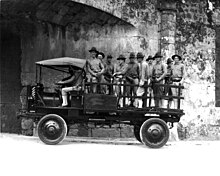
U.S. Marines riding in a Jeffery Quad, Fort Santo Domingo, c. 1916
The Jeffery Quad, and from the visitor's accept-over by Nash Motors afterward 1916, the Nash Quad truck, greatly assisted the Globe War I efforts of several Centrolineal nations, particularly the French.[26] The United states of america Marine Corps commencement adopted Quads in acrimony in the U.Due south. occupation of Haiti, and of the Dominican Republic, from 1915 through 1917.[27] The U.Due south. Army's offset heavy usage of Quads was nether general John "Blackjack" Pershing in the 1916 Pancho Villa Trek in Mexico — both as regular ship trucks, and in the form of the Jeffery armored car. Once the U.South.A. entered Earth War I, Nash Quads were used heavily in Pershing'due south subsequent campaigns in Europe, and they became the workhorse of the Allied Expeditionary Forcefulness there.[28] [29] Some eleven,500 Jeffery / Nash Quads were built between 1913 and 1919.[xxx]

Luella Bates driving a Model B, FWD truck – promotional photo.
The success of the Four Bike Drive cars in early on armed forces tests had prompted the company to switch from cars to truck manufacturing. In 1916 the U.South. Army ordered 147 FWD Model B, three-ton (6000 lb / 2700 kg) capacity trucks for the Mexico border Expedition,[31] and subsequently ordered an corporeality of 15,000 FWD Model B 3-ton trucks every bit the "Truck, 3 ton, Model 1917" during World War I, with over xiv,000 actually delivered. Additional orders came from the United Kingdom and Russia.[32] Once the FWD and Jeffery / Nash 4-wheel drive trucks were required in big numbers in Globe War I, both models were built under license by several additional companies to meet demand. The FWD Model B was produced under license by four boosted manufacturers.[31]
The Quad and the FWD trucks were the world'south start four-wheel drive vehicles to exist made in five-figure numbers, and they incorporated many hallmark technological innovations, that also enabled the decisive U.S. and Allied usage of 4x4 and 6x6 trucks in World State of war Two. The Quad'south production continued for 15 years with a total of 41,674 units made.[33]
Socially, information technology was the FWD company that employed Luella Bates, believed to be the commencement female truck driver, chosen to work every bit test and sit-in driver for FWD, from 1918 to 1922.[34] [35] During World War I, she was a test driver traveling throughout the state of Wisconsin in an FWD Model B truck. After the war, when the bulk of the women working at 4 Bike Drive were permit go, she remained every bit a demonstrator and driver.[34]
Farming and food [edit]

Nutrient Assistants poster 1917
The nutrient programme was a major success, as output expanded, waste was reduced, and both the dwelling front and the Allies received more food.[36] The U.S. Food Administration under Herbert Hoover launched a massive entrada to teach Americans to economize on their food budgets and abound victory gardens in their backyards.[37] Information technology managed the nation'southward nutrient distribution and prices.[38]
Gross subcontract income increased more than than 230% from 1914 to 1919. Apart from 'wheatless Wednesdays' and 'meatless Tuesdays' due to poor harvests in 1916 and 1917, there were 'fuelless Mondays' and 'gasless Sundays' to preserve coal and gasoline.[39]
Economic confusion in 1917 [edit]
In terms of munitions product, the starting time 15 months involved an amazing parade of mistakes, misguided enthusiasm, and confusion.[40] Americans were willing enough, but they did non know their proper part. Washington was unable to figure out what to exercise when, or even to determine who was in charge. Typical of the confusion was the coal shortage that hit in December 1917. Because coal was past far the major source of energy and heat a grave crisis ensued. There was in fact plenty of coal beingness mined, but 44,000 loaded freight and coal cars were tied up in horrendous traffic jams in the rail yards of the Due east Coast. Ii hundred ships were waiting in New York harbor for cargo that was delayed past the mess. The solution included nationalizing the coal mines and the railroads for the duration, shutting down factories one day a week to salvage fuel, and enforcing a strict system of priorities. Only in March, 1918, did Washington finally take control of the crisis[41] The transportation organization then worked smoothly.[42]
Shipments to Europe [edit]
Shipbuilding became a major wartime manufacture, focused on merchant ships and tankers.[43] Merchant ships were often sunk until the convoy system was adopted using British and Canadian naval escorts. Convoys were slow but effective in stopping u-gunkhole attacks.[44] The troops were shipped over on fast passenger liners that could easily outrun submarines.[45]
An oil crisis occurred in Great britain due to the 1917 German submarine campaign. Standard Oil of NJ, for instance, lost 6 tankers (including the brand new "John D. Archbold") between May and September. The solution was expanded oil shipments from America in convoys. The Allies formed the Inter-Allied Petroleum Conference with USA, Britain, French republic, and Italian republic as the members. Standard and Royal Dutch/Vanquish ran it and made it work. The introduction of convoys equally an antidote to the German U-boats and the articulation management system past Standard Oil and Royal Dutch/Shell helped to solve the Allies' supply problems. The shut working human relationship that evolved was in marked contrast to the feud between the government and Standard Oil years before. In 1917 and 1918, there was increased domestic demand for oil partly due to the common cold winter that created a shortage of coal. Inventories and imported oil from Mexico were used to close the gap. In January 1918, the U.S. Fuel Administrator ordered industrial plants east of Mississippi to close for a week to free up oil for Europe.[46]
The coal shortage caused abrupt increases in the demand and prices of oil and industry called for voluntary price control from the oil industry. While Standard Oil was agreeable, the independent oil companies were not. Demand continued to outpace supply because of the war and the growth in automobiles in America. An entreatment for "Gasolineless Sundays" in US was made with exceptions for freight, doctors, constabulary, emergency vehicles, and funeral cars.
Labor [edit]

1919 New York Herald cartoon portraying "reds" and IWW members as a violent mob held dorsum by threat of a United states of america Army machine gun
The American Federation of Labor (AFL) and affiliated trade unions were strong supporters of the war try. Fearfulness of disruptions to state of war product past labor radicals provided the AFL political leverage to proceeds recognition and mediation of labor disputes, often in favor of improvements for workers.[47] They resisted strikes in favor of mediation and wartime policy, and wages soared as about-total employment was reached at the elevation of the war. The AFL unions strongly encouraged young men to enlist in the military, and fiercely opposed efforts to reduce recruiting and slow war production by pacifists, the anti-state of war Industrial Workers of the Globe (IWW) and radical socialists. To keep factories running smoothly, Wilson established the National State of war Labor Board in 1918, which forced management to negotiate with existing unions.[48] Wilson too appointed AFL president Samuel Gompers to the powerful Council of National Defense force, where he set upwardly the War Committee on Labor.
After initially resisting taking a stance, the IWW became actively anti-war, engaging in strikes and speeches and suffering both legal and illegal suppression by federal and local governments equally well as pro-war vigilantes. The IWW was branded as anarchic, socialist, unpatriotic, alien and funded by German gold, and violent attacks on members and offices would go on into the 1920s.[49]
The AFL membership soared to 2.4 meg in 1917. In 1919, the AFL tried to make their gains permanent and called a series of major strikes in meat, steel and other industries. The strikes ultimately failed, forcing unions back to membership and power like to those effectually 1910.[50]
[edit]
African-Americans [edit]
With an enormous demand for expansion of the defense industries, the new draft law in effect, and the cut off of clearing from Europe, demand was very loftier for underemployed farmers from the South. Hundreds of thousands of African-Americans took the trains to Northern industrial centers. Migrants going to Pittsburgh and surrounding manufactory towns in western Pennsylvania between 1890 and 1930 faced racial bigotry and limited economic opportunities. The black population in Pittsburgh jumped from six,000 in 1880 to 27,000 in 1910. Many took highly paid, skilled jobs in the steel mills. Pittsburgh'southward black population increased to 37,700 in 1920 (six.4% of the total) while the blackness element in Homestead, Rankin, Braddock, and others nearly doubled. They succeeded in building effective community responses that enabled the survival of new communities.[51] [52] Historian Joe Trotter explains the determination process:
- Although African-Americans often expressed their views of the Great Migration in biblical terms and received encouragement from northern blackness newspapers, railroad companies, and industrial labor agents, they also drew upon family and friendship networks to help in the move to Western Pennsylvania. They formed migration clubs, pooled their money, bought tickets at reduced rates, and often moved ingroups. Before they made the decision to move, they gathered data and debated the pros and cons of the procedure....In barbershops, poolrooms, and grocery stores, in churches, guild halls, and clubhouses, and in private homes, southern blacks discussed, debated, and decided what was good and what was bad about moving to the urban Due north.[53]
Subsequently the war concluded and the soldiers returned home, tensions were very high, with serious labor spousal relationship strikes involving blackness strikebreakers and inter-racial riots in major cities. The summer of 1919 was the Crimson Summer with outbreaks of racial violence killing about 1,000 people beyond the nation, nearly of whom were black.[54] [55]
Women [edit]
During WWI (1914-1918), large numbers of women were recruited into jobs that had either been vacated by men who had gone to fight in the war, or had been created as office of the war endeavor. The loftier demand for weapons and the overall wartime situation resulted in munitions factories collectively condign the largest employer of American women by 1918. While there was initial resistance to hiring women for jobs traditionally held past men, the war fabricated the demand for labor so urgent that women were hired in big numbers and the government fifty-fifty actively promoted the employment of women in war-related industries through recruitment drives. As a upshot, women non only began working in heavy industry, but also took other jobs traditionally reserved solely for men, such every bit railway guards, ticket collectors, bus and tram conductors, postal workers, police officers, firefighters, and clerks.

Mary Van Kleeck led the Department of Labor effort to set employment standards for working women during the war
Globe War I saw women taking traditionally men's jobs in large numbers for the commencement time in American history. Many women worked on the assembly lines of factories, producing trucks and munitions, while department stores employed African American women as elevator operators and cafeteria waitresses for the offset fourth dimension. The Nutrient Assistants helped housewives prepare more nutritious meals with less waste and with optimum use of the foods available. Most of import, the morale of the women remained high, as millions joined the Red Cross as volunteers to help soldiers and their families, and with rare exceptions, the women did not protest the draft.[56] [57]
The Department of Labor created a Women in Industry group, headed by prominent labor researcher and social scientist Mary van Kleeck.[58] This group helped develop standards for women who were working in industries connected to the war aslope the War Labor Policies Board, of which van Kleeck was also a fellow member. Afterwards the state of war, the Women in Industry Service grouping developed into the U.Due south. Women'southward Agency, headed by Mary Anderson.[58] [59]
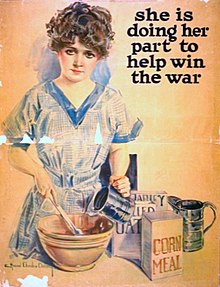
Girls likewise immature for paid jobs learned how they could help the war effort.
Children [edit]
World War I affected children in the United States through several social and economical changes in the school curriculum and through shifts in parental relationships. For example, a number of fathers and brothers entered the state of war, and many were later maimed in action or killed, causing many children to be brought upward by unmarried mothers.[60] Additionally, every bit the male workforce left for boxing, mothers and sisters began working in factories to have their positions, and the family dynamic began to change; this affected children as they had less time to spend with family members and were expected to grow up faster and help with the state of war endeavor. Similarly, Woodrow Wilson chosen on children involved in youth organizations to assistance collect coin for state of war bonds and stamps in order to raise money for the war attempt.[61] This was very important because the children were having a directly effect on the financial state of the United States authorities during Globe War I. As children were collecting large amounts of money outside of schoolhouse, within the classroom, curriculum also began to change as a outcome of the war. Woodrow Wilson again became involved with these children as he implemented authorities pamphlets and programs to encourage state of war support through things like mandatory patriotism and nationalism classes multiple times a week.[62] Even though state of war was not being fought on U.s.a. soil, children'south lives were greatly afflicted as all of these changes were fabricated to their daily lives as a result of the conflict.

Americanization of people with unlike ethnicities [edit]
The outbreak of war in 1914 increased concern about the millions of strange born in the The states. The short-term concern was their loyalty to their native countries and the long-term was their absorption into American society. Numerous agencies became agile in promoting "Americanization" then that people of differing ethnicities would be psychologically and politically loyal to the U.South. The states fix programs through their Councils of National Defense; numerous federal agencies were involved, including the Bureau of Didactics, the U.s. Department of the Interior and the Nutrient Administration. The most important private system was the National Americanization Committee (NAC) directed by Frances Kellor. Second in importance was the Committee for Immigrants in America, which helped fund the Segmentation of Immigrant Pedagogy in the federal Agency of Instruction.[63]
The state of war prevented millions of recently arrived immigrants from returning to Europe every bit they originally intended. The great majority decided to stay in America. Foreign language use declined dramatically. They welcomed Americanization, often signing up for English classes and using their savings to buy homes and bring over other family members.[64]
Kellor, speaking for the NAC in 1916, proposed to combine efficiency and patriotism in her Americanization programs. Information technology would be more than efficient, she argued, once the factory workers could all understand English and therefore amend empathize orders and avoid accidents. Once Americanized, they would grasp American industrial ideals and be open to American influences and non subject only to strike agitators or foreign propagandists. The result, she argued would transform indifferent and ignorant residents into understanding voters, to make their homes into American homes, and to establish American standards of living throughout communities of diverse ethnicities. Ultimately, she argued it would "unite strange-born and native alike in enthusiastic loyalty to our national ideals of freedom and justice.[65]
Alien internments [edit]
German citizens were required to register with the federal government and bear their registration cards at all times. two,048 German citizens were imprisoned showtime in 1917, and all were released by bound 1920. Allegations against them included spying for Germany or endorsing the German state of war effort. They ranged from immigrants suspected of sympathy for their native country, civilian German sailors on merchant ships in U.South. ports when war was declared, and Germans who worked part of the year in the U.s., including 29 players from the Boston Symphony Orchestra and other prominent musicians.[66]
Anti-German language activity [edit]

1918 bail posters with germanophobic slogans
High german Americans by this time usually had only weak ties to Deutschland; however, they were fearful of negative treatment they might receive if the United states entered the state of war (such mistreatment was already happening to German language-descent citizens in Canada and Australia). Well-nigh none chosen for intervening on Deutschland'southward side, instead calling for neutrality and speaking of the superiority of German civilisation. They were increasingly marginalized, withal, and by 1917 had been excluded nigh entirely from national soapbox on the subject field.[67]
When the war began, overt examples of German language culture came under set on. Many churches cut dorsum or ended their High german linguistic communication services. German parochial schools switched to the use of English language in the classroom. Courses in German were dropped from public high school curricula. Some street names were changed. One person was killed by a mob at a tavern in a southern Illinois mining town.[68]
War bonds [edit]
Elaborate propaganda campaigns were launched to encourage Americans to buy Liberty bonds. In ethnic centers, ethnic groups were pitted against each other and so that groups were encouraged to buy more than bonds compared to their celebrated rivals in social club to demonstrate superior patriotism.[69] [70] [71]
Attacks on the U.S. [edit]
The Central Powers carried out a number of acts of sabotage and a single submarine assail against the U.Southward. while beingness neutral and belligerent with the country during the war, but never staged an invasion, although there were rumors that German directorate were present at the Boxing of Ambos Nogales.
Sabotage [edit]
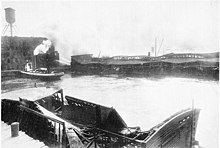
Black Tom Pier before long after the explosion.
Numerous rumors of German language plans for sabotage alarmed Americans. After midnight on July 30, 1916, a serial of small fires were institute on a pier in Bailiwick of jersey City, New Bailiwick of jersey. Sabotage was suspected and some guards fled, fearing an explosion; others attempted to fight the fires. Somewhen, they chosen the Jersey City Fire Section. An explosion occurred at 2:08 a.chiliad., the first and biggest of the explosions. Shrapnel from the explosion traveled long distances, some lodging in the Statue of Liberty and other places. Half dozen months later, on 11 Jan 1917, German agents ready fire at an armament assembly plant near Lyndhurst, New Jersey, causing a four-60 minutes burn down that destroyed one-half a million iii-inch explosive shells and destroyed the plant for an estimated at $17 1000000 in damages.
On July 21, 1918, a German U-boat, SMU-156, positioned itself off of Orleans, Massachusetts and opened burn and sank a tugboat and some barges until it was driven off by American warplanes.
See too [edit]
- American entry into World State of war I
- Victory garden
- Woman's Land Army of America
- Result of Globe State of war I on Children in the United states of america
- United States abode front during World War II
- German prisoners of war in the United states
- Home front during World War I, covering all major countries involved
- Women's roles in the World Wars#Globe War I
- British home front during the First Globe War
- History of Germany during World War I
- History of France during World War I
- Belgium in World War I
Notes and references [edit]
- ^ On the historiography, run into Justus D. Doenecke, "Neutrality Policy and the Determination for War" in Ross Kennedy ed., A Companion to Woodrow Wilson (2013) pp: 243-69 Online
- ^ For detailed coverage of Wilson's speech run into NY Times main headline, April 2, 1917, President Calls for War Announcement, Stronger Navy, New Army of 500,000 Men, Full Cooperation With Germany's Foes
- ^ Staff, History.com. "U.S. Entry into Globe War I." History.com, A&E Television Networks, 2017, www.history.com/topics/earth-state of war-i/u-s-entry-into-globe-state of war-i.
- ^ Spencer Tucker and Priscilla Mary Roberts, eds., World State of war I: encyclopedia (2005), p. 1205
- ^ Kennedy, Over Hither, 61-62
- ^ John Whiteclay Chambers II, To Raise an Army: The Draft Comes to Modern America (1987)
- ^ Edward A. :Gutièrrez, Doughboys on the Dandy State of war: How American Soldiers Viewed Their War machine Experience (2014)
- ^ Schaffer, Ronald (1978). The United States in World War I . Santa Barbara: Clio Books. p. ?. ISBN0874362741.
- ^ Fischer, Nick (2011). "The American Protective League and the Australian Protective League – Ii Responses to the Threat of Communism, c. 1917–1920". American Communist History. 10 (ii): 133–149. doi:10.1080/14743892.2011.597222. S2CID 159532719.
- ^ Steel, Ronald (1980). Walter Lippmann and the American Century . Boston: Niggling, Brown. p. 124. ISBN0316811904.
- ^ For archival holdings see "WWI Films at the National Archives in Higher Park, MD"
- ^ Mock, James R.; Larson, Cedric (1939). Words that Won the War: The Story of the Committee on Public Information, 1917–1919. Princeton University Press. pp. 151–152.
- ^ Michael T. Isenberg, "The mirror of democracy: reflections of the state of war films of Earth War I, 1917-1919," Journal of Pop Culture (1976) 9#four pp 878-885.
- ^ Michael T. Isenberg, "An Ambiguous Pacifism: A Retrospective on Earth War I Films, 1930-1938." Journal of Popular Film iv.2 (1975): 98-115.
- ^ Michael E. Birdwell, "A Modify of Center: Alvin York and the Movie Sergeant York." Film & History 27.one (1997): 22-33.
- ^ Steven Lobell, "The Political Economy of State of war Mobilization: From Britain'south Limited Liability to a Continental Delivery," International Politics (2006) 43#three pp 283–304
- ^ Engelbrecht, Helmuth Ballad; Hanighen, Frank Cleary (1934). Merchants of Death: A Study of the International Armament Industry. p. 187. ISBN9781610163903.
- ^ a b Westing, Frederick (1966), The locomotives that Baldwin congenital. Containing a complete facsimile of the original "History of the Baldwin Locomotive Works, 1831-1923", Crown Publishing Group, pp. 76–85, ISBN978-0-517-36167-2
- ^ Ayres, Leonard P. (1919). The State of war with Germany (2d ed.). Washington, DC: Us Government Printing Role. pp. 77&78.
- ^ M. J. Daunton, "How to Pay for the War: Country, Society and Taxation in United kingdom, 1917–24," English language Historical Review (1996) 111# 443 pp. 882–919 in JSTOR
- ^ "U.S. Cartridge Company" (PDF). Lowell Land Trust. Archived from the original (PDF) on 2013-04-26. Retrieved 2013-02-06 .
- ^ Chocolate-brown, John M. (1995), The Baldwin Locomotive Works, 1831-1915: A Study in American Industrial Practice, Studies in Industry and Guild serial, Baltimore: Johns Hopkins University Printing, pp. 216&228, ISBN978-0-8018-5047-9
- ^ a b Crowell, pp. 25-30
- ^ produced past UAW and Jeep (27 September 2007). Jeep: Steel Soldier (documentary). "Toledo Stories": PBS. Event occurs at two:08–2:51 min. Archived from the original on 2021-12-21. Retrieved 2020-x-21 .
- ^ Adolphus, David Traver (Baronial 2011). "Where none could possibly travel Jeffery'southward Quads became the backbone of both commerce and war". Hemmings Archetype Car . Retrieved 4 March 2018.
- ^ Shrapnell-Smith, Edmund (1915). Our Despatches from the Front: Huge Deliveries of Lorries for the French Government. Drivers for Quads. American Tire Sizes, in The Commercial Motor. Temple Press (since 2011, Route Transport Media). p. 229. Retrieved 6 Dec 2014.
- ^ Buckner, David Northward. (1981). Marine Corps Historical Sectionalisation (ed.). A Brief History of the 10th Marines (PDF). Washington D.C.: United States Marine Corps. 19000308400. Retrieved 3 March 2018.
- ^ Hyde, Charles (2009). The Thomas B. Jeffery Company, 1902-1916, in Storied Independent Automakers. Wayne State University Printing. pp. i–twenty. ISBN978-0-8143-3446-i . Retrieved 6 December 2014.
- ^ "Charles Thomas Jeffery". The Lusitania Resource. 25 July 2011. Retrieved 6 Dec 2014.
- ^ Mroz, Albert (2009). American Military Vehicles of World War I: An Illustrated History of Armored Cars, Staff Cars, Motorcycles, Ambulances, Trucks, Tractors and Tanks . McFarland. p. nineteen. ISBN978-0-7864-3960-7.
- ^ a b Karolevitz, Robert (1966). This Was Trucking: A Pictorial History of the first quarter century of the trucking industry . Seattle: Superior Publishing Company. p. 100. ISBN0-87564-524-0.
- ^ "FWD Model B". War machine Factory. Military Mill. Retrieved March 4, 2018.
- ^ Redgap, Curtis; Watson, Pecker (2010). "The Jefferys Quad and Nash Quad — 4x4 Ancestor to the Willys Jeep". Allpar. Retrieved six Dec 2014.
- ^ a b "Can a Daughter Be As Good a Mechanic Every bit a Man Is Question". Monongahela Pennsylvania Daily Republican. June 30, 1920 – via Newspapers.com.

- ^ Karolevitz (1966), folio 43.
- ^ Beamish and March (1919). America's Part in the World War. pp. 319–35.
- ^ "Didactics With Documents: Sow the Seeds of Victory! Posters from the Food Administration During World War I"
- ^ Nash, George H. (1996). The Life of Herbert Hoover: Main of Emergencies, 1917–1918. New York: Norton. p. ?. ISBN0393038416.
- ^ Tucker, Spencer C.; Roberts, Priscilla Mary (2005). Encyclopedia Of World War I: A Political, Social, And Military History. ABC-CLIO. p. 1206. ISBN9781851094202.
- ^ Allan R. Millett and Peter Maslowski, For the Mutual Defense (1994) pp 352–353.
- ^ Kennedy, Over Here 113-25
- ^ Beamish and March (1919). America's Part in the World State of war. pp. 336–50.
- ^ Beamish and March (1919). America's Part in the World State of war. pp. 359–66.
- ^ Brian Tennyson, and Roger Sarty. "Sydney, Nova Scotia and the U-Gunkhole State of war, 1918." Canadian Military History 7.i (2012): 4+ online
- ^ Holger H. Herwig, and David F. David. "The Failure of Majestic Deutschland's Undersea Offensive Against Earth Shipping, Feb 1917–October 1918." Historian (1971) 33#4 pp: 611-636.
- ^ Ferrier, Ronald W.; Bamberg, J. H. (1982). The History of the British Petroleum Company: Volume 1, The Developing Years, 1901-1932. Cambridge University Press. p. 356. ISBN9780521246477.
- ^ Joseph A. McCartin, Labor's great war: the struggle for industrial democracy and the origins of modern American labor relations, 1912-1921 (1997).
- ^ Richard B. Gregg, "The National War Labor Board." Harvard Law Review (1919): 39-63 in JSTOR
- ^ Robert L. Tyler, Rebels of the wood: the IWW in the Pacific Northwest (U of Oregon Printing, 1967)
- ^ Philip Taft, The A.F.L. in the time of Gompers (1957)
- ^ Joe W. Trotter, "Reflections on the Great Migration to Western Pennsylvania." Western Pennsylvania History (1995) 78#4: 153-158 online.
- ^ Joe West. Trotter, and Eric Ledell Smith, eds. African Americans in Pennsylvania: Shifting Historical Perspectives (Penn State Press, 2010).
- ^ Trotter, "Reflections on the Great Migration to Western Pennsylvania," p 154.
- ^ Jam Voogd, Race Riots & Resistance: The Blood-red Summertime of 1919 (Peter Lang, 2008).
- ^ David F. Krugler, 1919, The Twelvemonth of Racial Violence (Cambridge Upwards, 2014).
- ^ Gavin, Lettie (2006). American Women in World War I: They Besides Served. Bedrock: University Press of Colorado. ISBN0870818252.
- ^ Beamish and March (1919). America's Part in the World War. pp. 259–72.
- ^ a b "Biographical/Historical - Mary van Kleeck". findingaids.smith.edu. Smith College Special Collections. Retrieved 2019-09-05 .
- ^ "U.s.a. Women'due south Bureau | United States federal agency". Encyclopedia Britannica . Retrieved 2019-09-05 .
- ^ Greenwald, Maureen (1980). Maurine Weiner. Women, War, and Work: the Affect of World War I on Women Workers in the United States . Westport: Greenwood Press. p. four. ISBN0313213550.
- ^ McDermott, T. P. "USA's Boy Scouts and Globe War I Liberty Loan Bonds". SOSSI Periodical: 70.
- ^ Spring, Joel (1992). Images of American Life. Albany: Country University of New York Press. p. 20. ISBN0791410692.
- ^ McClymer, John F. (1980). State of war and Welfare: Social Engineering in America, 1890–1925 . Westport: Greenwood Printing. pp. 110–111. ISBN0313211299.
- ^ Archdeacon, Thomas J. (1984). Condign American . London: Collier Macmillan. pp. 115, 186–187. ISBN0029008301.
- ^ McClymer, War and Welfare, pp 112-3
- ^ New York Times: "Dr. Muck Bitter at Sailing," August 22, 1919, accessed January thirteen, 2010
- ^ Frederick C. Luebke, Bonds of Loyalty: German-Americans and Earth State of war I (1974)
- ^ Donald R. Hickey, "The Prager Affair: A Study in Wartime Hysteria," Journal of the Illinois State Historical Lodge (1969) 62#ii pp 126–127 in JSTOR
- ^ Alexander, June (2008). Indigenous Pride, American Patriotism: Slovaks And Other New Imiigrants. Temple UP. pp. 33–34. ISBN9781592137800.
- ^ Sung Won Kang and Hugh Rockoff. "Capitalizing patriotism: the Freedom loans of World State of war I." Financial History Review 22.1 (2015): 45+ online
- ^ For full coverage meet Charles Gilbert, American financing of World War I (1970) online
Further reading [edit]
- Beamish, Richard Joseph; March, Francis Andrew (1919). America'due south Part in the Earth War: A History of the Total Greatness of Our Country'south Achievements; the Tape of the Mobilization and Triumph of the Military machine, Naval, Industrial and Noncombatant Resource of the United States. Philadelphia: John C. Winston Company. ; comprehensive history of military and home front; total text online; has photos
- Breen, William J. Uncle Sam at Home: Civilian Mobilization, Wartime Federalism, and the Council of National Defense force, 1917-1919 (Greenwood Press, 1984)
- Chambers, John W., Ii. To Heighten an Regular army: The Typhoon Comes to Modern America (1987) online
- Clements, Kendrick A. The Presidency of Woodrow Wilson (1992) nline
- Cooper, John Milton. Woodrow Wilson: A Biography (2009) online
- Crowell, Benedict (1919). America's Munitions 1917-1918. Washington, DC: Regime Printing Function.
- Dumenil, Lynn. The Second Line of Defense: American Women and World War I (U of North Carolina Press, 2017). xvi, 340 pp.
- Encyclopædia Britannica (12th ed. 1922) comprises the 11th edition plus iii new volumes 30-31-32 that cover events since 1911 with very thorough coverage of the war as well equally every country and colony. Included besides in 13th edition (1926) partly online
- full text of vol 30 ABBE to ENGLISH HISTORY online free
- Gannon, Barbara A. "The Great War and Modern Amnesia: Studying Pennsylvania's Great State of war, Part 2' Pennsylvania History (2017) 84#3:287-91 Online
- Garrigues, George. Liberty Bonds and Bayonets, (Urban center Desk Publishing, 2020), the home front in St. Louis, Missouri ISBN 978-1651488423
- Hamilton, John M. Manipulating the Masses: Woodrow Wilson and the Nativity of American Propaganda. (Louisiana State University Press, 2020) online review
- Kennedy, David M. Over Here: The First World War and American Gild (2004), comprehensive coverage borrow for 14 days
- Link, Arthur Stanley. Woodrow Wilson and the Progressive Era, 1910–1917 (1972) standard political history of the era borrow for 14 days
- Link, Arthur Stanley. Wilson: The Struggle for Neutrality: 1914–1915 (1960); Wilson: Confusions and Crises: 1915–1916 (1964); Wilson: Campaigns for Progressivism and Peace: 1916–1917 (1965), the standard biography to 1918
- Malin, James C. The United States after the World War (1930) online [ expressionless link ]
- Meyer Yard.J. The World Remade: America In World War I (2017), pop survey, 672pp
- North, Diane M.T. California at War: The State and the People during World War I (2018) online review
- Paxson, Frederic L. Pre-war years, 1913-1917 (1936) wide-ranging scholarly survey
- Paxson, Frederic L. American at War 1917-1918 (1939) wide-ranging scholarly survey
- Philadelphia War History Committee (1922). Philadelphia in the World War, 1914-1919. total text online
- Schaffer, Ronald. America in the Great War: The Rise of the War-Welfare State (Oxford University Press, 1991), ISBN 0-19-504904-7
- Startt, James D.. Woodrow Wilson, the Great War, and the Fourth Estate (2017) online review
- Titus, James, ed. The Home Front and War in the Twentieth Century: The American Feel in Comparative Perspective (1984) essays by scholars. online free
- Tucker, Spencer C., and Priscilla Mary Roberts, eds. The Encyclopedia of Globe War I : A Political, Social, and Military History (5 vol. 2005)
- Vaughn, Stephen. Holding Fast the Inner Lines: Commonwealth, Nationalism, and the Commission on Public Information (1980) online
- Venzon, Anne ed. The United States in the Showtime World War: An Encyclopedia (1995), Very thorough coverage.
- Williams, William John. The Wilson assistants and the shipbuilding crisis of 1917: steel ships and wooden steamers (1992).
- Wilson, Ross J. New York and the Beginning World War: Shaping an American City (2014).
- Young, Ernest William. The Wilson Administration and the Not bad War (1922) online edition
- Zieger, Robert H. America's Peachy War: World War I and the American Experience 2000. 272 pp.
Economics and labor [edit]
- Gage, Robert D. The war industries board: Business-regime relations during Earth War I (1973).
- Cuff, Robert D. "The politics of labor administration during earth state of war I." Labor History 21.4 (1980): 546–569.
- Dubofsky, Melvyn. "Abortive reform: the Wilson administration and organized labor, 1913-1920." in Work, Customs, and Power: The Feel of Labor in Europe and America, 1900-1925 edited by James E. Cronin and Sirianni, (1983): 197–220.
- Haig, Robert Murray. "The Revenue Act of 1918," Political Science Quarterly 34#3 (1919): 369–391. in JSTOR
- Kester, Randall B. "The War Industries Board, 1917–1918; A Study in Industrial Mobilization," American Political Scientific discipline Review 34#four (1940), pp. 655–84; in JSTOR
- Myers, Margaret Yard. Financial History of the United states of america (1970). pp 270–92. online
- Rockoff, Hugh. "Until information technology'southward Over, Over At that place: The U.S. Economy in World State of war I," in Stephen Broadberry and Mark Harrison, eds. The Economics of World War I (2005) pp 310–43. online; online review
- Soule, George. The Prosperity Decade: From War to Low, 1917–1929 (1947), broad economic history of decade
- Sutch, Richard. "The Fed, the Treasury, and the Liberty Bond Campaign–How William Gibbs McAdoo Won World War I." Central Banking in Historical Perspective: One Hundred Years of the Federal Reserve (2014) online; Illustrated with wartime authorities posters.
Race relations [edit]
- Blumenthal, Henry. "Woodrow Wilson and the Race Question." Periodical of Negro History 48.ane (1963): one-21. online
- Breen, William J. "Black Women and the Great State of war: Mobilization and Reform in the South." Journal of Southern History 44#three (1978), pp. 421–440. online
- Ellis, Mark. "'Closing Ranks' and 'Seeking Honors': W. E. B. Du Bois in World War I." Journal of American History 79#1 (1992), pp. 96–124. online
- Finley, Randy. "Black Arkansans and World War One." Arkansas Historical Quarterly 49#iii (1990): 249-77. doi:10.2307/40030800.
- Hemmingway, Theodore. "Prelude to Modify: Black Carolinians in the War Years, 1914-1920." Journal of Negro History 65#3 (1980), pp. 212–227. online
- Jordan, William. "'The Damnable Dilemma': African-American Accommodation and Protestation during World War I." Journal of American History 82#four (1995), pp. 1562–1583. online
- Krugler, David F. 1919, The Year of Racial Violence (Cambridge UP, 2014).
- Patler, Nicholas. Jim Crow and the Wilson assistants: protesting federal segregation in the early twentieth century (2007).
- Scheiber, Jane Lang, and Harry N. Scheiber. "The Wilson assistants and the wartime mobilization of blackness Americans, 1917–18." Labor History 10.3 (1969): 433-458.
- Smith. Shane A. "The Crunch in the Great War: W.E.B. Du Bois and His Perception of African-American Participation in World War I," Historian 70#2 (Summer 2008): 239–62.
- Yellin, Eric Southward. (2013). Racism in the Nation's Service. doi:10.5149/9781469607214_Yellin. ISBN9781469607207. S2CID 153118305.
Historiography and memory [edit]
- Controvich, James T. The The states in Earth War I: A Bibliographic Guide (Scarecrow, 2012) 649 pp
- Higham, Robin and Dennis E. Showalter, eds. Researching World State of war I: A Handbook. (2003). 475pp; highly detailed historiography.
- Keene, Jennifer D. "Remembering the 'Forgotten War': American Historiography on World War I." Historian 78#3 (2016): 439–468.
- Licursi, Kimberly J. Lamay. Remembering World War I in America (2018)
Primary sources and year books [edit]
- Creel, George. How We Advertised America: The Beginning Telling of the Amazing Story of the Committee on Public Information That Carried the Gospel of Americanism to Every Corner of the Earth. New York: Harper & Brothers, 1920.
- George Creel Sounds Phone call to Unselfish National Service to Paper Men Editor and Publisher, Baronial 17, 1918.
- United States. Committee on Public Information. National service handbook (1917) online gratis
- Negro Year Book 1916
- New International Year Volume 1914, Comprehensive coverage of national and state affairs, 913pp
- New International Year Book 1915, Comprehensive coverage of national and state affairs, 791pp
- New International Yr Book 1916 (1917), Comprehensive coverage of national and state affairs, 938pp
- New International Year Book 1917 (1918), Comprehensive coverage of national and state affairs, 904 pp
- New International Year Volume 1918 (1919), Comprehensive coverage of national and state affairs, 904 pp
- New International Year Book 1919 (1920), Comprehensive coverage of national and state affairs, 744pp
- New International Twelvemonth Book 1920 (1921), Comprehensive coverage of national and state affairs, 844 pp
- New International Year Book 1921 (1922), Comprehensive coverage of national and land affairs, 848 pp
External links [edit]
- Keene, Jennifer D.: United States of America, in: 1914-1918-online. International Encyclopedia of the Start World War.
- Ford, Nancy Gentile: Civilian and Military Power (USA), in: 1914-1918-online. International Encyclopedia of the First World State of war.
- Jensen, Kimberly: Women's Mobilization for War (The states), in: 1914-1918-online. International Encyclopedia of the First Earth War.
- Strauss, Lon: Social Conflict and Control, Protest and Repression (Usa), in: 1914-1918-online. International Encyclopedia of the First Globe State of war.
- Taillon, Paul Michel: Labour Movements, Merchandise Unions and Strikes (Usa), in: 1914-1918-online. International Encyclopedia of the First World State of war.
- Lilliputian, Branden: Making Sense of the War (United states), in: 1914-1918-online. International Encyclopedia of the First World War.
- Miller, Alisa: Press/Journalism (USA), in: 1914-1918-online. International Encyclopedia of the Beginning World War.
- Wells, Robert A.: Propaganda at Home (United states), in: 1914-1918-online. International Encyclopedia of the Offset Globe War.
- Dwelling house front of Connecticut in Globe War I
- N Carolinians and the Not bad State of war: Introduction to the Home Front end
washingtongise1957.blogspot.com
Source: https://en.wikipedia.org/wiki/United_States_home_front_during_World_War_I
0 Response to "What events led up to the U. S. entering WWI? Describe how it affected our home front."
Postar um comentário